
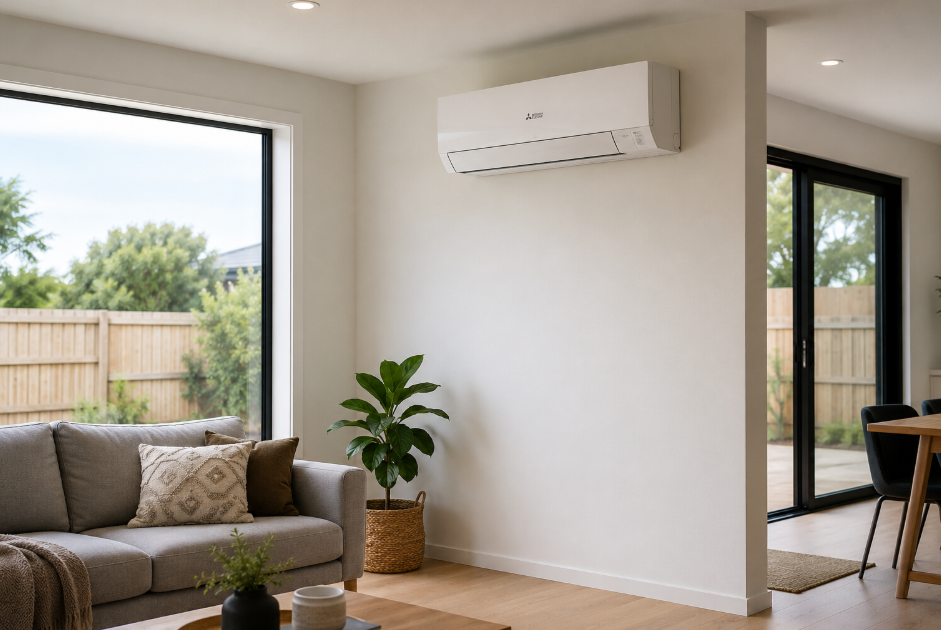
A well-positioned heat pump can distribute warm or cool air more effectively, operate efficiently and maintain a more consistent temperature throughout the room. Put the same unit in the wrong location and you may experience uneven temperatures, unwanted draughts or a system that has to work harder than necessary.
At Bay of Plenty Heat Pumps, we install Mitsubishi Electric heat pumps throughout Tauranga, Mount Maunganui, Papamoa and the wider Bay of Plenty. Before recommending a system, we consider not only the size of the space but also the room layout, insulation, windows, airflow and the most suitable positions for both the indoor and outdoor units.
So, where should your heat pump go?
What Is the Best Position for an Indoor Heat Pump?
For a typical high-wall heat pump, the best position is generally high on a wall where the unit can distribute air freely across the room.
The aim is to create good airflow throughout as much of the space as possible rather than directing all the heated or cooled air into one small area.
Every home is different, but an installer will typically consider:
- The size and shape of the room
- Where people spend most of their time
- Doorways and adjoining spaces
- Window size and location
- Ceiling height
- Existing insulation
- Furniture placement
- Where the outdoor unit can be installed
- The practical route for pipework and drainage
This is why choosing a heat pump based purely on room dimensions isn't always enough. Two living rooms of identical size can require different installation approaches because their layouts, glazing and insulation are completely different.
Should a Heat Pump Be Installed High or Low?
It depends partly on the type of heat pump.
High-wall heat pumps are mounted towards the upper part of a wall and are the most familiar type found in New Zealand homes. Their elevated position allows conditioned air to circulate throughout the room while keeping the unit out of the way.
Floor-console heat pumps, on the other hand, are positioned close to floor level. They can be particularly useful where wall space is limited or where the layout of a room makes a traditional high-wall unit impractical.
Floor consoles can also suit certain renovations where homeowners want a heating solution positioned similarly to a conventional heater.
The right choice therefore isn't simply a question of whether high or low is better. It depends on the room and how you want to heat and cool it.
Where Should a Heat Pump Go in an Open-Plan Living Area?
Large open-plan kitchens, dining rooms and living areas are common in modern Tauranga homes, but they can present more of a challenge than a simple rectangular room.
Ideally, the indoor unit needs to be positioned where airflow can reach the largest proportion of the open space without being obstructed by walls, cabinetry or furniture.
Simply installing the heat pump on the most convenient available wall may not produce the best result.
The capacity of the heat pump also becomes particularly important in open-plan spaces. A unit that's too small may struggle to maintain the desired temperature across the entire area.
Bay of Plenty Heat Pumps has an online heat pump calculator that provides a useful starting point based on room dimensions and insulation, although open-plan and multi-room spaces are best assessed individually.
Should You Put a Heat Pump in the Hallway?
This is a common question, particularly when homeowners want one heat pump to warm several bedrooms.
It can sound logical: put a heat pump in the hallway and allow the warm air to travel through the bedroom doors.
In practice, however, one hallway heat pump isn't necessarily the most effective way to achieve even temperatures across several separate rooms.
Air doesn't automatically distribute evenly through doorways and around corners. The hallway itself can reach the desired temperature before the bedrooms do, potentially reducing how effectively the system continues heating the areas you actually want warm.
If your objective is heating or cooling several bedrooms, it may be worth considering a multi-room or ducted system rather than assuming a single hallway unit will do the job.
Mitsubishi Electric's OmniCore system, for example, allows multiple indoor units to operate from one outdoor unit, while ducted central heating can distribute conditioned air throughout multiple areas of a home. Bay of Plenty Heat Pumps offers both options.
Should a Heat Pump Be Positioned Above a Window?
Not necessarily.
The best location is determined by airflow, available wall space, installation requirements and the characteristics of the room, rather than a rule that the unit must sit above a window.
In some homes an area near a window may provide a suitable position; in others there will be a much better location elsewhere.
This is another reason it's worth having the room assessed before deciding where you want the unit installed.
Where Should You Avoid Installing an Indoor Heat Pump?
A heat pump needs unobstructed airflow to work effectively.
As a general principle, avoid positioning the indoor unit where large furniture, shelving or architectural features significantly interfere with airflow.
You should also consider where the air will be directed. A powerful stream of cool air aimed directly at a sofa, dining table or bed may be uncomfortable even though the room itself is at the correct temperature.
The objective is effective circulation rather than simply blowing conditioned air directly at people.
Where Should the Outdoor Heat Pump Unit Go?
The outdoor unit also needs careful consideration.
It requires adequate airflow around it so that it can operate correctly, and its position needs to allow for servicing and maintenance.
Other practical considerations can include:
Noise: Modern Mitsubishi Electric systems are designed for quiet operation, but positioning still matters, particularly near bedrooms or neighbouring properties.
Weather and exposure: The unit is designed for outdoor use, but its location should still be carefully selected.
Accessibility: Technicians need reasonable access for future servicing.
Appearance: Homeowners understandably don't always want an outdoor unit prominently visible from entertaining areas or the street.
Bay of Plenty Heat Pumps has previously covered ways of making outdoor units less visually prominent, but any enclosure or screening needs to preserve the airflow required by the system.
Can One Heat Pump Heat the Whole House?
Sometimes, but not always.
A single heat pump can work extremely well in an appropriately sized open-plan area, but expecting one unit to evenly heat multiple closed bedrooms, bathrooms and living spaces is different.
For whole-home comfort, you may be better suited to:
Multiple individual heat pumps – separate units for key rooms.
Mitsubishi Electric OmniCore – multiple indoor units connected to one outdoor system.
Ducted central heating – conditioned air distributed through ducts to multiple areas.
The right solution depends on the home's size, layout, insulation and how independently you want to control temperatures in different rooms.
Does Heat Pump Position Affect Efficiency?
It can.
Even an appropriately sized heat pump needs to move air effectively around the space.
If airflow is restricted or the system is poorly positioned for the room it's trying to condition, achieving an even temperature can become more difficult.
Correct sizing and positioning therefore need to be considered together.
Bay of Plenty Heat Pumps already has a detailed guide explaining why correctly sizing a heat pump matters, including the problems associated with both undersized and oversized systems.
Get Your Heat Pump Position Right Before Installation
Once a heat pump is installed, moving it isn't as straightforward as moving a portable heater. That's why it's worth getting the location right from the beginning.
At Bay of Plenty Heat Pumps, we can assess your home and recommend the appropriate Mitsubishi Electric heat pump, capacity and installation position based on the room rather than relying on a one-size-fits-all recommendation.
We install Mitsubishi Electric heat pumps throughout Tauranga, Mount Maunganui, Papamoa and the wider Bay of Plenty, with options including high-wall heat pumps, floor consoles, OmniCore multi-room systems and ducted central heating.
If you're considering a new heat pump, talk to our team about the best system — and the best place to install it — for your home.
FAQs
Where is the best place to put a heat pump?
Generally, a high-wall heat pump should be positioned where it can distribute air freely throughout the room without furniture or other obstacles restricting airflow. The ideal location depends on the room's size, shape, glazing, insulation and layout.
Should a heat pump face the couch?
Not necessarily. You want good airflow around the living area without creating an uncomfortable stream of heated or cooled air directly onto people sitting beneath or opposite the unit.
Can I put a heat pump in a hallway to heat bedrooms?
You can, but it may not distribute heat evenly into multiple bedrooms. For several separate rooms, a multi-room or ducted heat pump system may provide more consistent temperature control.
Where should the outdoor heat pump unit be installed?
The outdoor unit needs sufficient airflow, appropriate clearance and reasonable access for servicing. Noise, appearance, neighbouring properties and the route between the indoor and outdoor units should also be considered.
Can one heat pump heat several rooms?
It depends heavily on the home's layout. One heat pump can condition a large open-plan space effectively, but moving air through doorways and around corners into separate rooms is more difficult. Multi-room or ducted systems may be more suitable.
Does it matter where a heat pump is installed?
Yes. Correct positioning helps the system distribute heated or cooled air effectively. Heat pump capacity, room layout and installation location should therefore be considered together.